Francis Deck, Bassist
String Bass | Electric Bass
Are you looking for HPF-Pre? Click here: https://sites.google.com/site/hpftechllc/
Music
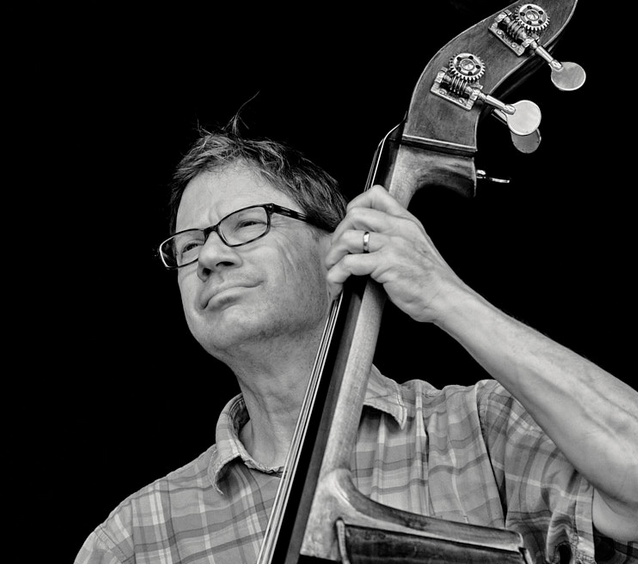
Thanks for visiting my page. If you're looking for a versatile upright or electric bassist you've come to the right place! My experience includes more than three decades of freelance jazz gigs, symphonic and chamber groups, pit orchestras, ethnic dance bands, and so forth. I offer a complete range of skills, including fluent sight-reading, improvisation, knowledge of the standard jazz repertoire, and simply being easy to deal with.
I moved to Madison in 1997, and have played with numerous local groups, on a regular or freelance basis. Presently, I play with the Madison Jazz Orchestra, Inside Pocket, Soul Call, and Swingtime Music.
Electronics and Speakers
Related to music, I'm an electronics and audio hobbyist. As I accumulate results, if they're interesting, then I write them up to share. Often, I find that writing a brief report helps me critique my own ideas, and also attracts helpful comments that improve my knowledge.
Professional
By day, I'm a senior staff scientist with Thermo Fisher Scientific Corp., the world leader in serving science. It's a great place to work. I have a PhD in physics, 20+ patents, and extensive experience in development of optical and electronic instrumentation systems. Many of my projects involve combinations of optics, electronics, embedded systems, and software development.
Blogs, Articles, Projects
7/19/2026 New 8 inch bass speaker design: This is a re-build of my little 8 inch bass speaker. I wanted to try a tilt-back design, but added a couple of other minor improvements as well.
3/13/2026 Online speaker modeling program (updated): This is a basic speaker modeling program that started as an exercise to learn Javascript. It has proven a lot easier to maintain than the later Python version, so I'm going to keep it up to date from now on. This version reconciles the math formulas with my latest derivations in the speaker theory repo.
12/25/2024 Speaker Theory: I've re-written my derivation of the speaker response formulas using SymPy, the symbolic algebra package for Python. It doesn't change any of my results or programs, but is less error prone and more maintainable than writing derivations by hand and typing them in to the Markdown editor. Also, the symbolic and numerical calculations are tied together, avoiding the problem of "two sets of books."
1/17/2023 Optical Ray Tracing (GitHub repo): This is a primitive optical ray tracing program, in the form of a Jupyter notebook.
1/3/2023: Measuring Noise and low-noise test amplifier. These articles document my technique for measuring very low levels of electronic noise using mainstream hardware and software. I used this setup to test a new design.
Older stuff:
12-inch bass speaker design article: I built this speaker in 2006, and it's still alive and kicking. I've included a brief technical write-up and sketches of construction plans. It uses an Eminence DeltaLite 2512-ii driver, which is one of the first neodymium-magnet drivers suitable for bass speaker use. Newer drivers outperform the 2512-ii in terms of power handling, but what I've got is more than I'll ever need for all of my gig work.
4th order high pass filter: This circuit was an early prototype for HPF-Pre Series 3, but I chose to proceed with an op amp circuit instead. So I'm sharing this strange but true discrete filter design here.
Bare-bones bass blender: This is another prototype for something that I decided not to commercialize at the time. It's a two channel preamp / mixer with active bass and treble controls, and additional features.
JFET bass preamp: A complete bass preamp using discrete JFET circuitry: Gain, bass, treble, mid with variable center frequency, and volume.
This site
This site is mostly written in Markdown and Jupyter notebooks, then converted automatically to HTML for ease of browsing. Thanks to Github for hosting this.
People who visited this site also enjoyed...
Taking a nap.